

The Ultimate Guide to Brand Identity Design: Everything You Need to Succeed in 2026
Brand identity design is no longer a cosmetic exercise. In 2026, it is the primary differentiator between market leaders and those struggling for relevance. If you view your brand as merely a logo and a color palette, you are operating on an obsolete playbook. A modern brand identity is a comprehensive strategic system that communicates authority, builds immediate trust, and drives measurable business outcomes.
For industrial, engineering, and B2B sectors, the stakes are higher. Your customers are not making emotional impulse buys; they are mitigating risk. They are looking for a partner who demonstrates precision, reliability, and technical dominance. To succeed, your identity must project these values across every touchpoint, from your website to your service vehicles.
The Anatomy of Modern Brand Identity
A logo is a signature, but identity is the entire personality and promise of your business. In the current landscape, your brand identity design must be motion-first and AI-ready. This does not mean adding unnecessary “flash.” It means creating a visual language that remains consistent whether it is viewed on a high-definition monitor, a smartphone, or an augmented reality interface.
The result of a fragmented identity is a loss of credibility. When your social media presence feels disconnected from your technical datasheets, you signal a lack of internal discipline. In the engineering and industrial worlds, discipline is everything. You must establish a unified system where typography, color theory, and imagery work in concert to tell a single, coherent story.
The Focal Point Approach: Isolating Your Difference
Most businesses fail to define what actually makes them different. They rely on generic claims like “quality service” or “innovative solutions.” These are not differentiators; they are the bare minimum. At Focal Point, we utilize a specific “focal point” approach to hone in on the unique essence of your business. We strip away the noise to find the one thing you do better than anyone else.
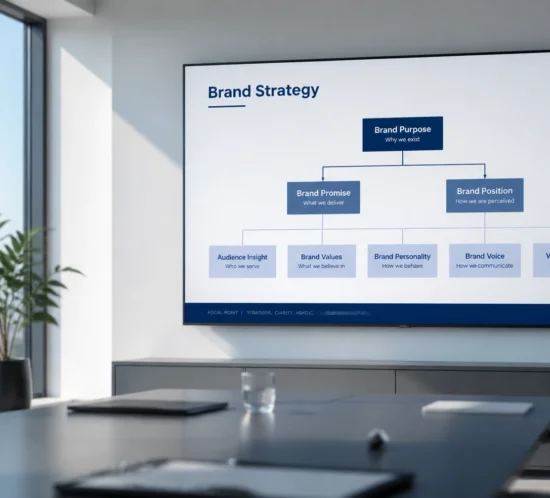
This process is the foundation of our Brand Strategy. We immerse ourselves in your business to understand the intersection of your technical expertise and your customers’ deepest pain points. Only after defining this strategy do we begin the creative execution. This ensures that every visual element: from the weight of a font to the style of a photograph: is rooted in a strategic “why.” Without this foundation, your branding is just decoration.

Consistency Across the Digital Ecosystem
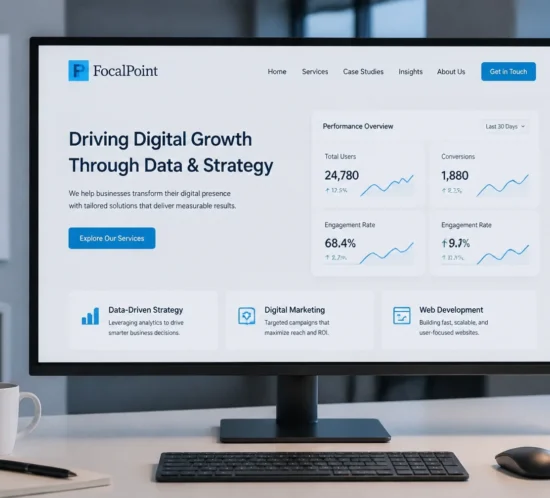
Your digital presence is the most visible manifestation of your brand. If your Web Design is outdated, your engineering expertise is immediately questioned. In 2026, a website must act as a 24/7 lead generation engine that reinforces your authority through every interaction. This requires a shift toward minimalist, grid-based layouts that prioritize clarity over clutter.
Consistency must extend into the fourth dimension: time. Video Production is no longer an optional add-on; it is a core component of brand storytelling. Whether it is a high-speed timelapse of a construction project or a detailed 3D animation of a mechanical process, your video content must share the same visual DNA as your website and your print materials. This level of cohesion is what a professional branding agency provides. It ensures that when a prospect sees a video on LinkedIn and then visits your site, the transition is seamless and the trust is reinforced.

Driving Trust in Technical Sectors
In industrial and engineering markets, trust is built through “cold-blooded professionalism.” This is a clinical, data-driven aesthetic that values utility and precision. You must leverage trust signals as first-class design elements. This includes the prominent display of certifications, safety awards, and technical specifications.
Authentic photography is a non-negotiable requirement. In 2026, the market is saturated with generic AI-generated imagery and stale stock photos. To stand out, you must show the reality of your operations. High-quality photography of your facilities, your specialized equipment, and your actual team members provides a level of transparency that no stock image can replicate. It proves you are a real entity with real expertise.

A Directive for Brand Evolution
Evolution is not a one-time event; it is a continuous process of refinement. If your brand has not been updated in the last three years, you are already behind. Follow these steps to begin your brand evolution:
- Audit Your Touchpoints: Review every piece of collateral your customers see. If the visual style varies between your sales decks, your website, and your service uniforms, you have a consistency problem that is eroding trust.
- Define Your Singular Focus: Identify the one technical or operational advantage that sets you apart. If you cannot articulate it in one sentence, your brand identity will never be sharp enough to penetrate a crowded market.
- Invest in High-Fidelity Assets: Replace amateur photography and low-quality video. In a high-stakes B2B environment, the quality of your visual assets is directly correlated to the perceived quality of your work.
- Prioritize the User Experience: Ensure your digital platforms are designed for the way your customers actually work. This means fast load times, intuitive navigation, and easy access to technical data.

The goal of brand identity design is to make the decision-making process easy for your customers. By presenting a clear, consistent, and professional image, you eliminate the friction of doubt. You transition from being a vendor to being a trusted partner. This is the ultimate objective of every branding effort we undertake at Focal Point. We don’t just build brands; we build the foundations for long-term business growth.